Building Re-tuning (BRT) Playbook
New York City needs you! Specifically, NYC needs the help of building operators and energy managers like you. Why? Because New York City now has laws that make it a global leader in the fight against climate change. Most notable and relevant is NYC’s Building Emission Law (LL97) which sets a goal of 40% reduction of citywide emissions by 2030. Buildings account for about 68% of total greenhouse gas (GHG) emissions in NYC. A majority of these GHG emissions come from building’s energy use, therefore making energy efficiency a top priority for NYC officials.
And no one in New York City is better positioned to quickly improve energy efficiency on a large scale than building operators and energy managers. No one.
It has been proven that using Building Re–tuning (BRT) techniques is the most cost–effective way to reduce building’s greenhouse gas emissions. As a result, this playbook successfully utilizes BRT to identify clear paths to low–cost and no–cost opportunities in energy efficiency that show instantaneous energy savings potential.
What's in the Playbook?
This playbook contains step–by–step guidance on how to save energy at your building by helping you develop new insights into how to improve operational efficiency with your existing systems. The goal of this playbook is to establish the common ground between operators and energy managers in our collective and critical efforts to maximize energy efficiency across our great city.
The playbook will show you how to select trends, make trend charts, analyze the trends, implement measures, and calculate savings.
BRT is an iterative process illustrated by the following steps:
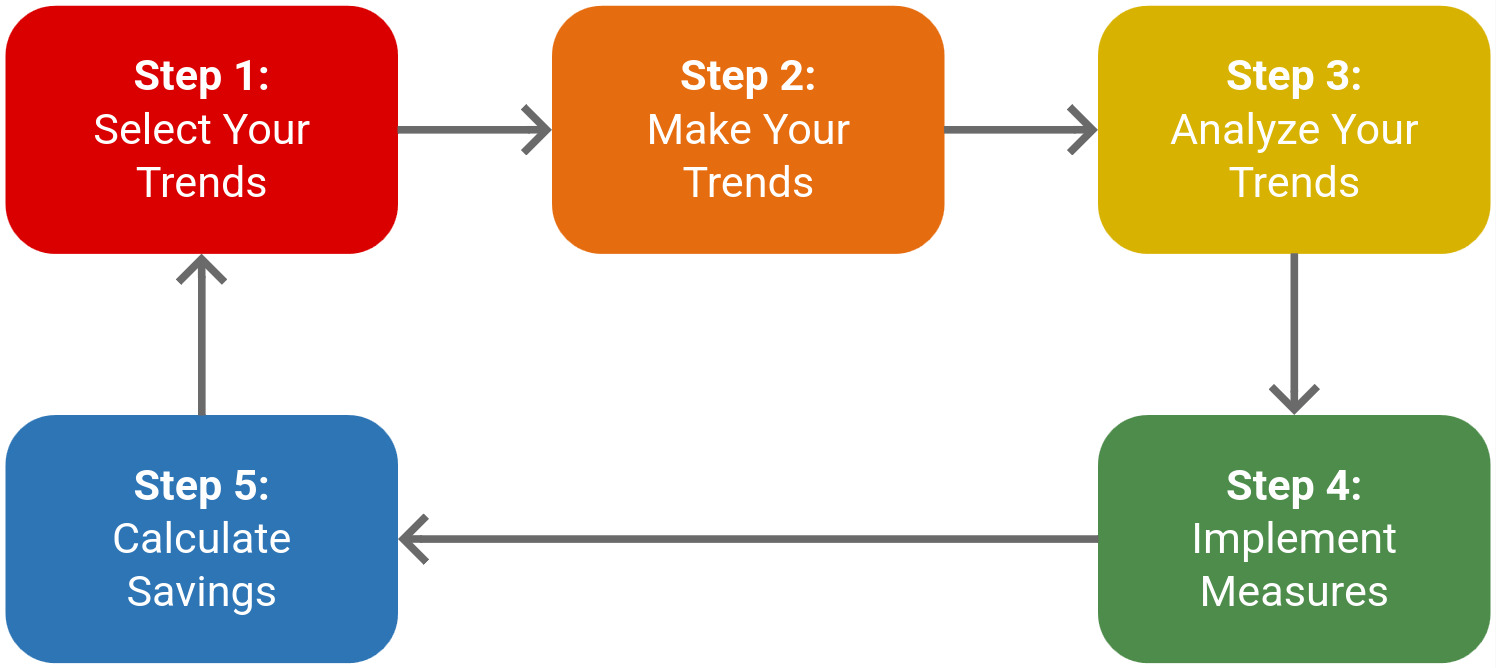
Step 1 Select Your Trends
The Playbook provides a comprehensive list of trend charts, organized by building systems, in order of highest to lowest impact on energy. You can use the measures list to focus on specific measures for implementation.
Step 2 Make Your Trends
The Playbook provides lists of the parameters (aka BAS points) to trend for each chart in Step 1. You can use these lists to guide you through making your trends.
Step 3 Analyze Your Trends
In this step, the Playbook will help you analyze your trends to find opportunities for energy savings, thus allowing you to translate findings into actions.
Step 4 Implement Measures
Depending on what you plan to do, there are many different avenues you can take. The Playbook offers guidance on getting measure implemented, in the general order of increasing expense and effort.
Step 5 Calculate Savings
An estimation of your energy savings can be calculated in various ways. The playbook provides you guidance on tools that can help calculate savings: Enetrac, EC3 and BRT Energy Savings Calculators.